Fishing Guide
Peacock bass fishing
on Gatun Lake.
A complete guide to peacock bass on Gatun Lake, Panama. Species biology, realistic sizes, techniques, and what to expect.
Introduction
The reason people fly to Panama.
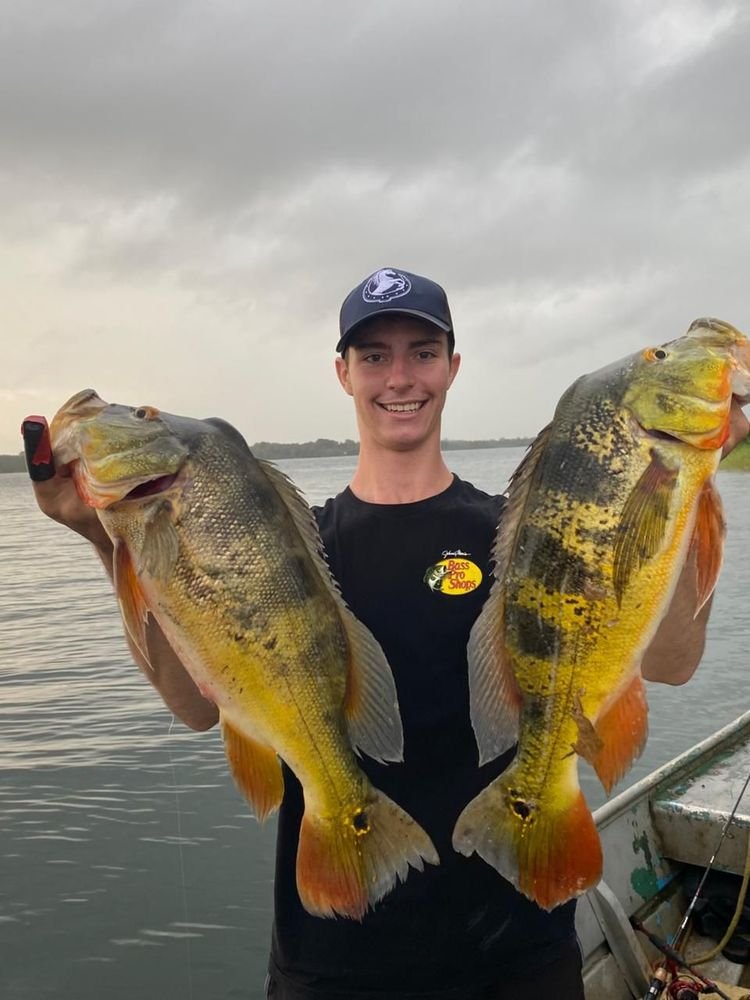
Peacock bass (Cichla ocellaris) are the primary target of every sport fishing charter on Gatun Lake. They're aggressive, they hit topwater lures hard, and their colors don't look real when you hold one in the boat. This guide covers everything you need to know before your first trip: how big they actually get, where they live on Gatun Lake, when to fish, what techniques work, and what to expect on the water.
Written by Capt. Luke Cowan, owner and lead guide at PanalakeSportfishing, based in La Arenosa on the western shore of Gatun Lake. Every fact below is drawn from thousands of guided trips on this specific water.
The species
What is a peacock bass?
Despite the name, peacock bass aren't bass. They're a species of cichlid native to the Amazon basin. Sport fishermen introduced them to Gatun Lake in the 1960s to control an invasive tilapia population. It worked. Peacock bass thrived, established a self-sustaining population, and turned Gatun Lake into what many consider the most productive peacock bass fishery outside the Amazon.
They're predators. They ambush baitfish, they crush topwater lures, and they fight like fish twice their size. A three-pound peacock bass will run harder and jump higher than most largemouth twice its weight. That's the appeal.
Realistic sizing
How big do peacock bass get on Gatun Lake?
Honesty matters here because a lot of online content overstates trophy sizes on Gatun Lake. Here's what actually holds up on the water:
- 1 to 2 lbstypical size for most peacock bass caught
- 3 lbs and upconsidered a big fish on Gatun Lake
- 5 lbsa true trophy, most anglers land one or two per trip in a good week
- 7 lbsrare, fish this size are caught here, but not often
- 8 lbs and abovepossible but exceptional
Amazon peacock bass grow larger, fish over 20 lbs exist in Brazil. Gatun Lake fish are smaller on average because the lake's ecosystem supports a different growth ceiling. What you gain in exchange is quantity. On a good day you'll release 20-40 fish, some running to trophy size.
Where they live
Peacock bass habitat on Gatun Lake.
Gatun Lake was formed when the Chagres River was dammed in the early 1900s to feed the Panama Canal. That flooded a jungle. What's underwater now is drowned forest, thousands of standing dead trees, submerged coves, flooded creek mouths, and endless structure. Peacock bass hold in that structure.
The productive water is where the drowned timber lays and hydrilla grows. Creek mouths are often prime spots for larger fish, particularly in the dry season when water levels drop. Shallow flats with scattered timber and hydrilla beds are where topwater bites happen at dawn, and fish hold on the drop-offs through the day, often providing productive mid-day bites.
Techniques
How we fish for peacock bass.
Four approaches in priority order. Each has its moment.
Live bait
Our number-one approach. Peacock bass eat live bait year-round, and it's how we consistently put guests on the biggest fish in the biggest numbers. Best for anglers who want maximum action or trophies.
Hard jerkbaits
Second-most productive. Peacock bass and snook both smash them on sight when the fish are active. Best in overcast conditions or when fish are chasing bait in the mid-column.
Topwater poppers
The most fun way to catch peacock bass, but seasonal. When the fish are shallow and chasing bait, poppers produce surface explosions on nearly every cast. Best at dawn and in the last hour before sunset.
Jigs & twitchbaits
Small crappie jigs, bucktail jigs, and hard twitchbaits round out the tackle box. We almost never use soft plastics on Gatun Lake, hard baits and live bait consistently outperform them.
Gear
What we rig on the boat.
You don't need to bring anything. Every trip includes rods, reels, and tackle chosen for the day's conditions. For reference: we run medium-to-medium-heavy spinning setups spooled with 20-30 lb braid, tipped with fluorocarbon leader. It's enough to horse trophy fish out of thick timber without being overkill on smaller peacocks.
If you want to bring your own rod, you're welcome to. Bass tackle from home works fine on Gatun Lake. Bring gear rated for 3-5 lb fish that can pull hard through structure.
When to fish
Peacock bass fish year-round.
Unlike many other sport fish, peacock bass are catchable every month of the year on Gatun Lake. The dry season (roughly December through April) offers the most stable conditions, clearest water, and easiest boat access to shallow structure. The wet season (May through November) brings rising water, refreshed structure, and fewer boats on the water, but rain gear is essential.
For a detailed breakdown, see our month-by-month guide to Gatun Lake fishing seasons.
Conservation
Catch, photo, release.
We're catch-and-release focused. Peacock bass populations on Gatun Lake are healthy because most guides on this water treat them right: quick photos, back in the water fast. Guests are welcome to keep a couple of fish for dinner as they are absolutely delicious (we clean and fillet on the boat), but we do not fill coolers. This fishery stays this good because we look after it.
Book
Ready to catch one?
Trip options at PanalakeSportfishing:
- Half Day (6 hours)$275 up to 3 anglers, $25 per extra, max 5
- Full Day (8 hours)$325 up to 3 anglers, $25 per extra, max 5, most popular
- Extended Day (12 hours)$550 up to 3 anglers, $35 per extra, max 5
See full trip details on our charter trips page, or read what guests say on our reviews page.
Ready to fish
Book your trip
on the water.
One WhatsApp message, straight to Capt. Luke Cowan.